Managed AI agents that complete workflows end-to-end
Reception & routing
Routes callers based on intent, department, and priority, not menu options. → Calls are intelligently directed to the right queue, team, or system with full context preserved.
Overflow & after-hours
Captures missed calls when teams are busy or offline. → Customers are progressed automatically with summaries, callbacks, or routed actions instead of voicemail dead-ends.
Service triage & intake
Collects the exact information your team needs before a human gets involved. → Inputs are structured and written directly into your helpdesk, CRM, or workflow ready to act on.
Urgent escalation
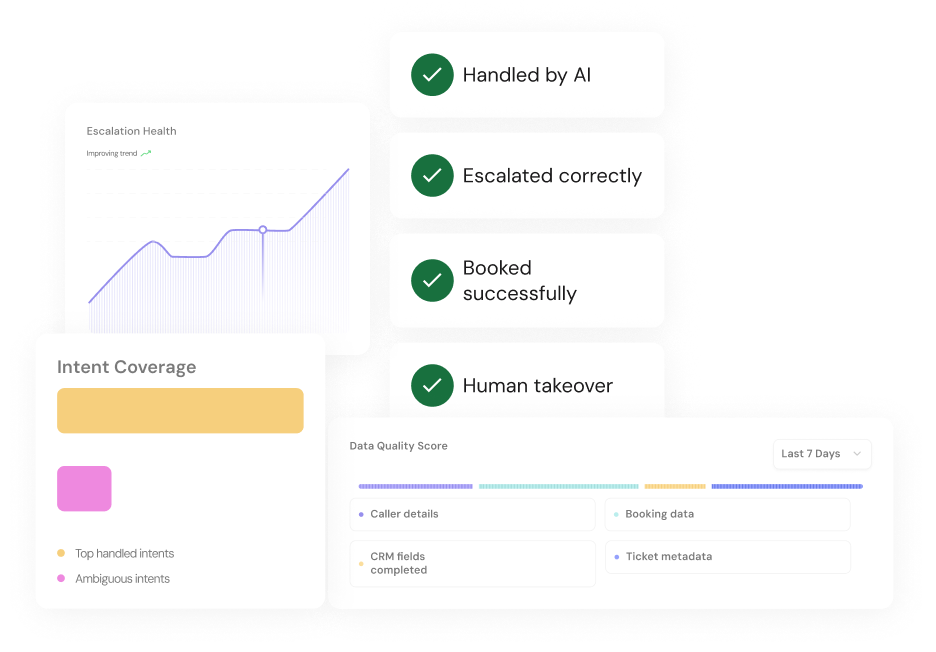
Identifies urgency in real time and enforces escalation rules you define. → Critical calls are warm-transferred or routed to on-call staff with a full audit trail.
Book & reschedule
Handles bookings, changes, and availability checks in real time, even across legacy systems. → Appointments are committed with the right context, rules, and constraints enforced automatically.
Confirmations
Confirms attendance and captures changes without manual follow-up. → Updates are written back to the source system and relevant teams are notified instantly.
Reminders
Reduces no-shows through intelligent, timing-aware reminders. → Responses are tracked and reflected directly in booking records, not lost in messages.
Capacity-aware escalation
Detects when availability, rules, or exceptions don't align. → Calls are escalated, rerouted, or converted into callbacks with full booking context attached.
Closes the loop on missed inbound calls within defined time windows. → Callbacks capture intent and outcome, then update your systems so nothing is left hanging.
Speed-to-lead follow-up
Engages new leads automatically within SLA thresholds. → Calls qualify interest, capture key details, and route qualified prospects to the right team or booking flow.
Operational follow-ups
Handles confirmations, renewals, and status updates at scale. → Outcomes are recorded and exceptions are escalated to humans with full context attached.
Payment follow-up
Executes controlled reminder workflows where tone and timing matter. → Cases are categorised (paid, dispute, hardship) and escalated according to your defined policies.
Performance is actively monitored so workflows don't drift over time. → Conversation outcomes, containment rates, and edge cases are reviewed and refined against agreed objectives.
Escalation policies
Human handoff rules are explicitly defined and enforced. → Calls are warm-transferred, routed, or converted into callbacks with full context when thresholds are met.
Change control & audit trail
Updates are managed through controlled change processes, not ad-hoc edits. → Every change is logged with what changed, why it changed, when it was applied, and the resulting impact.
Reporting & data integrity
All interactions are captured in structured, auditable formats. → Reporting surfaces outcomes, escalation rates, completeness, and quality — not just transcripts.
We map your existing systems, workflows, and data requirements before building. → Integrations are designed to fit your stack, policies, and edge cases, not force you into generic templates.
Custom integration builds
Connects to modern APIs, legacy systems, and internal databases without forcing replacements. → Whether it's REST APIs, SOAP services, or proprietary systems - we build the connections your workflows need.
Secure data handling & residency
Data is managed according to your security, compliance, and residency requirements. → Enterprise deployments support dedicated infrastructure, AU/NZ data residency, and isolated environments where required.
Purpose-built infrastructure
For complex enterprise requirements, we build dedicated infrastructure tailored to your environment. → Custom databases, isolated tenancy, and bespoke architectures for regulated or high-security deployments.
No. LayerAI is deployed as operational call workflows: intake, triage, booking, escalation, and follow-up — designed to produce structured outcomes and hand off cleanly to humans when needed.
What happens when the AI can’t handle a call?
It escalates based on your rules: warm transfer, priority callback booking, or routing to the right team/queue. You decide the triggers (urgency, vulnerability, complaints, policy categories, etc.).
How long does it take to deploy?
Lite can be live quickly (simple call capture). Pro and Enterprise depend on workflow complexity and integrations. The delivery model is: design → deploy → govern → operate.
Can it work as overflow only (not replace reception)?
Yes. Many deployments start as overflow/after-hours and expand into additional workflows once performance is proven.
What can it integrate with?
We integrate with most modern business systems including CRM platforms (Salesforce, HubSpot), helpdesk/ticketing systems (ServiceNow, Zendesk), booking/scheduling tools, and communication platforms. We’ll confirm your specific stack compatibility during the demo.
Do you support outbound calling?
Yes — for governed workflows like speed-to-lead follow-up, missed-call recovery, renewals, confirmations, and payment follow-up (where appropriate). Outbound is deployed to your policies and consent requirements.
How do you handle security, governance, and procurement?
We provide comprehensive onboarding documentation including security reviews, compliance attestations, and vendor assessment materials. Our platform operates with enterprise-grade change control and full audit trails.
Where is data hosted?
Hosting and data residency options vary by deployment tier. Our Enterprise tier supports dedicated infrastructure, data residency controls (AU/NZ available), and stronger isolation where required. We’ll discuss your specific requirements during onboarding.
What does “monitoring and tuning” actually mean?
We review call outcomes, escalation rates, failed intents, and data quality. We tune workflows and knowledge sources so performance improves over time instead of degrading after launch.
What plan do most teams start on?
Most teams start with Lite for overflow or Pro for multi-intent workflows. Enterprise is for higher volume, stricter governance, or dedicated infrastructure needs.
Enterprise ready onboarding
Security and governance documentation available
Deployment options aligned to AU/NZ enterprise environments
Clear operating model and accountability after go-live